
Table of Contents
Introduction: A Real User Problem
Imagine this: In how-to guides and tutorials, you bought an unused smartphone. It’s your to begin with time utilizing this brand, and the interface looks totally diverse from what you are utilized to. You need to exchange all your contacts, set up email, and customize your settings, but you don’t know where to begin. Looking for online assistance, you discover hundreds of articles, recordings, and gatherings. You tap on a “step-by-step guide,” and abruptly, everything makes sense.
This is not a fair or irregular story; it is something most individuals encounter day by day. Whether it’s learning a modern aptitude, fathoming a domestic issue, or overseeing innovation, individuals frequently battle to discover straightforward and solid enlightenment. How-To Guides, Tutorials, and instructional exercises unravel this issue by giving clear, organized, enlightening instructions that anybody can follow.

Clear Explanation
A how-to guide is an asset that clarifies precisely how to do something. An instructional exercise is exceptionally comparable but frequently gives more in-depth learning and, in some cases, incorporates demonstrations. They both serve the same purpose: making a difference. Individuals learn or illuminate an issue efficiently.
The fundamental objective of these guides is to make the handle simple to get it. For illustration, if somebody needs to heat a cake for the to begin with time, a great instructional exercise will clarify the fixings, the devices required, and each step from blending to preparing, including tips for avoiding mistakes.
These guides can come in numerous forms:
- Written articles: Step-by-step, enlightening with images.
- Video instructional exercises: Appear the handle outwardly and regularly incorporate voice instructions.
- Infographics: Utilize pictures and charts to clarify quickly.
- Interactive instructional exercises: Found in apps or computer programs, permitting you to attempt steps as you learn.
The advantage is clear: in place of speculating or testing aimlessly, you have a guide. This spares time, diminishes blunders, and frequently increases certainty in completing a task.
Step-by-Step Guide
Let’s consider how a how-to guide works in real life. We’ll utilize an illustration: “How to Set Up a Domestic Wi-Fi Network.”
Step 1: Accumulate the equipment
Before beginning, make beyond any doubt you have the switch, modem, control cables, and a gadget to design the arrangement (like a portable workstation or smartphone). A direct will tell you precisely what is required, so you don’t squander time looking for lost items.
Step 2: Interface the modem to the internet
The instructional exercise clarifies how to interface your modem to the wall outlet and at that point connect it to the switch. A few guides, how-to guides, and tutorials incorporate pictures showing where the cables ought to go, making it much simpler to get it than reading a manual.
Step 3: Design the router
Next, a step-by-step instructional exercise will direct you through logging into the router’s settings, choosing a organize title (SSID), and setting a solid watchword. An apprentice might feel overpowered, but a clear informational break breaks the handle into little, sensible tasks.
Step 4: Interface gadgets to Wi-Fi
Finally, the instructional exercise clarifies how to interface your computer, phone, or keen gadgets to the Wi-Fi network. A few guides indeed give troubleshooting tips if a gadget cannot connect.
By taking after a organized process like this, somebody who has never set up a Wi-Fi arrangement recently can complete the task effectively in less than an hour. Without a direct approach, it may take hours of trial and blunder, disappointment, and conceivably, a call to specialized support.
Benefits of How-To Guides & Tutorials
Spare Time
Time is one of the greatest reasons individuals depend on how-to guides and tutorials. Instead of figuring out a plan from scratch, you can take after a pre-made plan. For example, learning to introduce a modern app on your computer through an instructional exercise takes 10 minutes instead of speculating for an hour.
Diminish Mistakes
Guides give a guide. They frequently highlight common botches and clarify how to maintain a distance from them. For occasion, an instructional exercise on changing a car tire will caution you not to remove the jolts while the car is still on the ground. This makes the handle more secure and more effective.
Increment Confidence
Trying something unused can be threatening. How-To Guides and Tutorials provide individuals certainty by breaking down assignments into small, achievable steps. If somebody is learning to paint for the first time, taking a class makes a difference so they can see progress rapidly, which empowers further learning.
Learn at Your Own Pace
Tutorials permit you to learn when it suits you. You can delay, replay, or peruse once more. This adaptability is especially valuable for complex subjects, like coding, photography, or cooking complicated recipes.
Accessibility
Most guides are accessible online for free. This makes information open to individuals anywhere in the world. You don’t need to go to costly classes or enlist specialists; the data is at your fingertips.
Assortment of Learning Styles
Different individuals learn in distinctive ways. A few favor perusing, a few observing recordings, a few utilizing intelligently work out. How-To Guides and Tutorials, and directions work out cater to all these learning styles, making instruction and problem-solving more effective.
Drawbacks of How-To Guides & Instructional Exercises
While they are exceptionally valuable, there are a few downsides to be mindful of:
- Information Overburden: There are so many guides online that it can be overpowering to select the right one.
- Quality Varieties: Not all instructional exercises are exact. A few contain obsolete or inaccurate data, which can lead to mistakes.
- Dependence: A few individuals might depend as well intensely on instructional exercises and battle to fathom issues independently.
- Time-Consuming for Complex Points: A few errands are exceptionally complicated, and following a direct step-by-step can still take a considerable amount of time.
- Safety Concerns: For physical assignments like electrical work or domestic repairs, erroneous direction can be dangerous.
Safety or Best-Practice Tips
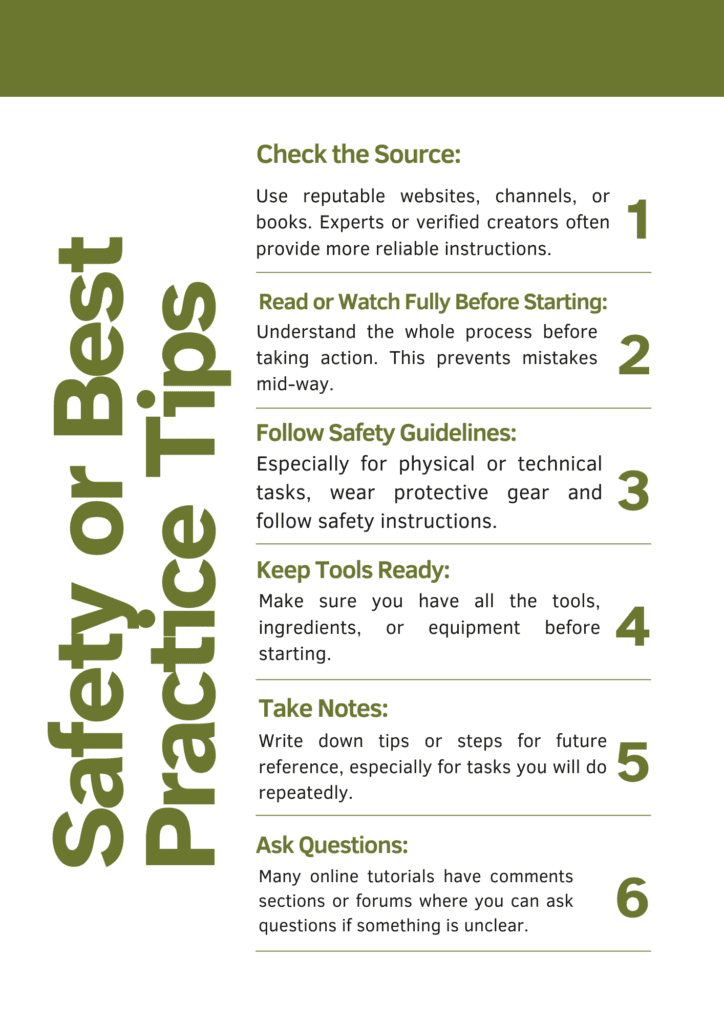
- Check the Source: Utilize legitimate websites, channels, or books. Specialists or confirmed makers regularly give more dependable instructions.
- Read or Observe Completely Some time recently Beginning: Get the entire preparation some time recently, taking action. This avoids botches mid-way.
- Follow Security Rules: Particularly for physical or specialized errands, wear defensive gear and follow security instructions.
- Keep Devices Prepared: Make beyond any doubt you have all the devices, fixings, or hardware some time recently starting.
- Take Notes: Compose down tips or steps for future reference, particularly for assignments you will do repeatedly.
- Ask Questions: Numerous online instructional exercises have comment areas or forums where you can ask questions if something is unclear.
- Test Little Steps To begin with: If the errand permits, attempt a little portion to begin with to guarantee you get it it some time recently committing fully.
By taking these tips into account, you can maximize the benefits of how-to guides while minimizing dangers.
Real-Life Illustrations of How-To Guides
How-To Guides and Tutorials are all over in our day-to-day lives. Let’s look at a few common scenarios:
Cooking and Recipes
Cooking is one of the most common areas where individuals depend on instructional exercises. Whether it’s a fledgling attempting to make mixed eggs or an experienced cook endeavoring a gourmet dish, step-by-step formulas make it possible to follow along without mistakes.
For illustration, a basic formula for a chocolate cake will include:
- Ingredients with measurements
- Step-by-step blending instructions
- Baking time and temperature
- Decorating tips
Following such a direct approach avoids blunders, like undercooking or utilizing the off-base fixing, and makes a difference that individuals appreciate the process without stress.
Domestic Repairs and DIY Projects
DIY ventures are another zone where instructional exercises sparkle. Individuals often utilize how-to guides as much as possible:
- Fix spilling faucets
- Paint dividers or furniture
- Assemble furniture from stores like IKEA
Without a direct endeavor, these assignments might result in wasted materials or indeed harm. Instructional exercises not only clarify the steps but also highlight the instruments required and security safety measures, guaranteeing tasks are completed proficiently and safely.
Innovation and Gadgets
From smartphones and tablets to savvy domestic gadgets, innovation regularly comes with a learning curve. How-to guides offer assistance to users:
- Set up modern devices
- Transfer information between gadgets
- Troubleshoot errors
For instance, instructional exercises on setting up a smart thermostat can incorporate wiring charts, app setup steps, and investigating tips, empowering clients to oversee their domestic environment easily.
Learning Modern Skills
Learning a modern expertise is simpler with instructional exercises. Individuals utilize them for:
- Photography and video editing
- Programming and coding
- Playing melodic instruments
- Fitness routines
Video instructional exercises, in specific, give visual demonstrations that make it less demanding for learners to follow along. They break complex abilities into straightforward, repeatable steps, decreasing dissatisfaction and expanding motivation.
Proficient Errands and Career Development
How-To Guides and Tutorials are not fair for pastimes; they are broadly utilized in professional settings. Workers can discover guides for:
- Using computer programs like Exceed expectations, Photoshop, or AutoCAD
- Conducting advertise research
- It also permits workers to learn freely, making strides in working environment productivity.
The Part of How-To Guides in Education
How-To Guides and Tutorials, and instructional exercises have changed advanced instruction. Conventional instruction frequently depends on lectures and course readings, which may not suit all learning styles. Instructional exercises offer a few advantages:
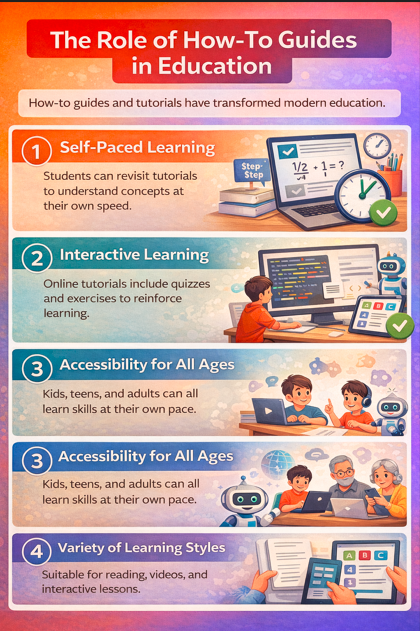
Self-Paced Learning
Students can learn at their claim speed. If an understudy battles with a concept in math or science, they can return to the instructional exercise until they fully understand it.
Intuitively Learning
Many online instructional exercises incorporate tests, exercises, and intelligent modules. This hands-on approach fortifies learning superior to detached reading.
Energizes Long-lasting Learning
How-To Guides and Tutorials advance self-education past school. Individuals can learn new leisure activities, progress proficient abilities, or investigate inventive interfaces at any age.
Impact on Individual Development
Using how-to guides routinely can have significant impacts on individual growth:
Builds Confidence
Completing an assignment after taking an instructional exercise gives a sense of achievement. This energizes people to attempt more complex tasks and take on modern challenges.
Energizes Problem-Solving
When taking after instructional exercises, clients frequently experience startling issues. Overcoming these issues creates basic critical thinking and problem-solving skills.
Spares Time and Decreases Stress
Knowing there is a clear guide decreases uneasiness. Whether settling something at home or learning an unused ability, having direction makes the process less stressful.
Advances Creativity
Once fundamental abilities are acquired through instructional exercises, individuals regularly begin testing and improving. For illustration, after learning a preparation formula, somebody might make their own varieties, combining abilities with creativity.
Bolsters Independence
Tutorials enable people to handle errands without depending on specialists. This autonomy can be especially valuable in ordinary life, from domestic repairs to overseeing individual finances.
Broader Impact on Society
How-To Guides and Tutorials don’t offer assistance to individuals—they affect society as a whole:
Diminishes Reliance on Services
By educating individuals how to perform errands themselves, instructional exercises diminish dependence on experts for basic occupations. This can spare cash for families and diminish the demand for fundamental services.
Encourages Information Sharing
Online instructional exercises make a culture of sharing. Specialists and devotees contribute their information, making it open around the world. This democratizes learning and interfaces individuals globally.
Empowers Computerized Literacy
Using online instructional exercises requires exploring the web, looking successfully, and assessing sources. Over time, clients create more grounded computerized abilities, which are fundamental in cutting-edge life.
Underpins Little Businesses and Entrepreneurs
Tutorials offer assistance to business people to learn abilities like promoting, website building, and accounting. This engages little businesses and contributes to financial growth.
Restrictions and How to Overcome Them
Clients should be careful of impediments:
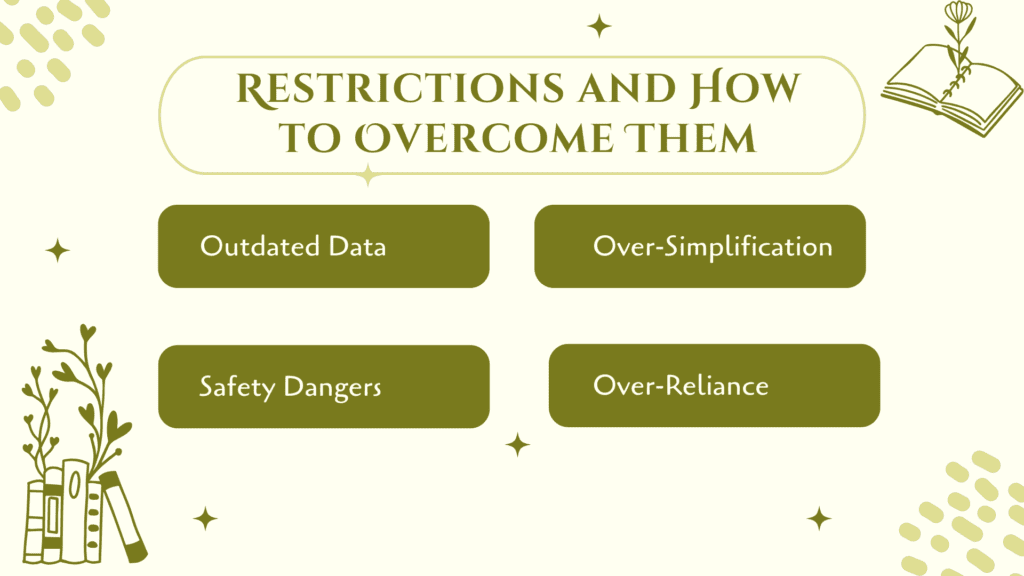
- Outdated Data: Innovation and strategies alter rapidly. Continuously check the distribution date or look for upgraded guides.
- Over-Simplification: A few instructional exercises take off on points of interest. Cross-referencing numerous sources makes a difference in guaranteeing accuracy.
- Safety Dangers: Certain errands, like electrical work or overwhelming apparatus utilization, may be unsafe if instructions are not followed appropriately. Look for proficient offer assistance when needed.
- Over-Reliance: Depending exclusively on instructional exercises can restrain imagination and free problem-solving. It’s imperative to adjust direction with experimentation.
By being careful of these restrictions, clients can maximize the benefits while minimizing risks.
Conclusion: Supportive Advice
How-To Guides, Tutorials, and instructional exercises have become a basic portion of advanced life. They make learning unused aptitudes simpler, save time, diminish mistakes, and increase certainty. They enable people to handle day-to-day assignments, improve individual development, and indeed impact society emphatically by sharing information and advancing self-reliance.
To make the most of tutorials:
- Choose Solid Sources – See for specialists, confirmed channels, or trusted websites.
- Follow Informational Carefully – Peruse or observe the full directions some time recently starting.
- Practice Security – Utilize defensive equipment and follow security tips for physical tasks.
- Experiment After Learning – Utilize instructional exercises as an establishment, at that point attempt your own variations.
- Keep Learning – Utilize guides routinely to construct modern aptitudes, remain overhauled, and proceed developing by and by and professionally.
In a rundown, how-to guides and instructional exercises are not fair instructions—they are tools that enable individuals to improve productivity, and energize long-lasting learning. By grasping them keenly, anybody can explore challenges, create abilities, and improve their day-to-day life in important ways.
Frequently Asked Questions (FAQs)
What are how-to guides and tutorials?
How-to guides and instructional exercises are step-by-step instructions that educate individuals on how to complete a particular task. They clarify forms clearly so clients can follow along effectively and dodge mistakes.
Why are how-to guides vital in day-to-day life?
How-to guides offer assistance to individuals to illuminate regular issues, save time, diminish stretch, and learn modern abilities. They make complex assignments less demanding and permit individuals to do things on their own without professional help.
How do instructional exercises offer assistance to beginners?
Tutorials break assignments into basic steps, making them simple for fledglings to get. They regularly incorporate cases, pictures, or recordings that offer assistance learners pick up certainty and avoid confusion.
What sorts of how-to guides are most common?
Common sorts incorporate cooking formulas, DIY domestic repair guides, innovation instructional exercises, wellness schedules, educational lessons, and professional expertise instructional exercises, such as computer program or marketing guides.
Are online instructional exercises reliable?
Many online instructional exercises are solid, but quality shifts. It’s critical to utilize trusted websites, master makers, or well-reviewed sources and check the date to guarantee the data is up to date.