Table of Contents
Introduction:
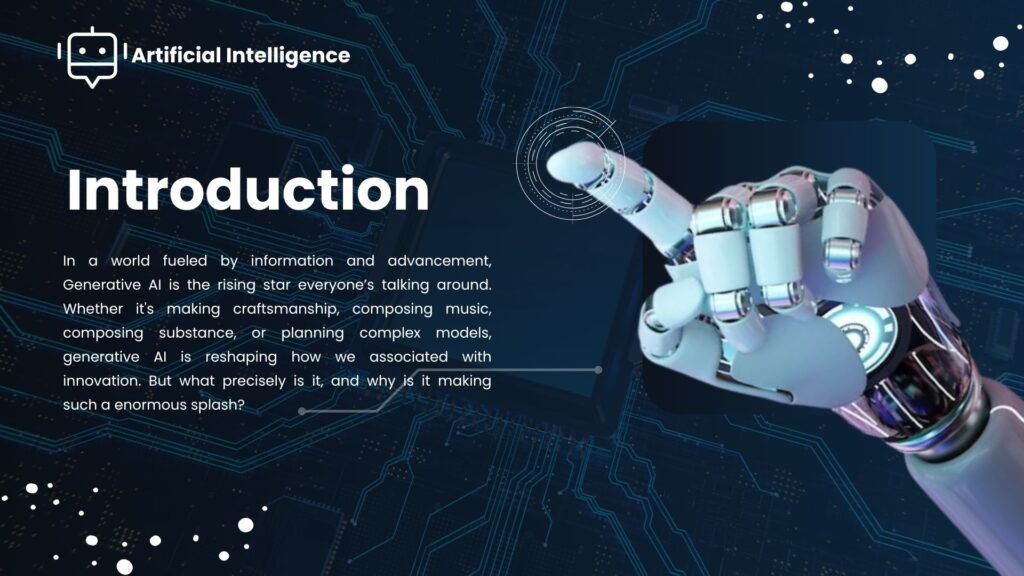
In a world fueled by information and advancement, Artificial Intelligence Generative is the rising star everyone’s talking about. Whether it’s making craftsmanship, composing music, composing content, or planning complex models, generative AI is reshaping how we associate with innovation. But what precisely is it, and why is it making such an enormous splash?
Understanding the Nuts and Bolts of Generative AI
Definition and Center Concept:
Artificial Intelligence Generative refers to fake experiences systems that deliver unused content—text, pictures, sound, video, and, without a doubt, code—based on plans learned from existing data. Not at all like conventional AI, which centers on classification or forecasting, generative AI makes something new.
How It Varies from Conventional AI:
Traditional AI fathoms particular tasks like recognizing faces or forecasting stock prices. Generative AI, on the other hand, can envision modern faces or compose modern music—essentially making substance that never existed before.
Examples of Generative AI in Action:
ChatGPT is producing human-like text
DALL·E making unique pictures from prompts
Deepfake innovation is utilized in videos
AI music generators are composing unused tunes
How Generative AI Works
The Part of Machine Learning:
Artificial Intelligence Generative models are prepared utilizing machine learning procedures where they learn designs, styles, and structures from tremendous datasets. Over time, they get better at copying and innovating.
Neural Systems & Profound Learning:
Deep learning, particularly neural systems, lies at the heart of generative AI. These systems mirror the way the human brain forms data, empowering the AI to learn highlights and designs autonomously.
Training Information & Demonstrate Optimization:
To produce quality yields, models must be prepared on gigantic, differing datasets. Fine-tuning and optimization offer assistance in anticipating issues like redundancy, inclination, or unreasonable results.
Sorts of Generative AI Models
Generative Antagonistic Systems:
GANs comprise two neural networks—the generator and the discriminator—that compete with each other. The generator makes substance, whereas the discriminator assesses it. This tug-of-war comes about in high-quality, reasonable outputs.
Variational Autoencoders:
VAEs are models that learn to compress information into a smaller representation and, at that point, reproduce it.
Transformer-Based Models:
These models prepare dialect utilizing consideration components, making them ideal for characteristic dialect era.
Key Applications Over Industries
Art & Design:
AI-generated craftsmanship is booming. From making advanced canvases to planning logos, devices like Midjourney and DALL·E are giving craftsmen modern imaginative partners.
Music & Entertainment:
AI composes music, composes scripts, and indeed plans video game characters. Companies like AIVA are pushing boundaries in AI-generated soundtracks.
Marketing & Advertising:
Artificial Intelligence Generative makes a difference by making advertisement duplicates, promoting visuals, and indeed video campaigns custom-fitted to target groups of people with pinpoint personalization.
Software Development:
AI instruments compose code, investigate programs, and indeed create full app prototypes—saving designers time and effort.
Healthcare and Biotech:
Healthcare and Biotech
From medication revelation to personalized treatment plans, generative AI is revolutionizing medication by modeling complex natural data.
Benefits of Generative AI
Boosting Creativity:
It’s like giving craftsmen and makers a superpower. You give the thought, and AI makes a difference, bringing it to life.
Efficiency & Fetched Reduction:
Why spend weeks on a promotional video when AI can produce one in hours? Generative AI cuts generation time and cost.
Personalization at Scale:
AI can tailor content for diverse groups of onlookers in real-time, making personalization more adaptable than ever before.
Challenges and Limitations
Ethical Concerns:
Who possesses the substance AI produces? Can it be utilized to spread deception? These questions are raising genuine moral debates.
Data Inclination & Misuse:
If AI is prepared on one-sided information, it can imitate those inclinations in its outputs—leading to unjustifiable or hostile results.
Copyright & Proprietorship Issues:
If an AI makes a tune that sounds like Taylor Quick, who claims the rights? This gray range is still being investigated legally.
Generative AI Apparatuses You Ought to Know
ChatGPT:
Used for text-based tasks—chatbots, composing, client support, and more
DALL·E:
Generates shocking pictures from content prompts—great for creators and marketers.
Midjourney:
An inventive play area for specialists utilizing AI to thrust visual boundaries.
Runway ML:
An effective video and interactive media altering stage fueled by generative models.
The Affect on Employment and the Workforce
Automation vs. Augmentation:
While a few fear work misfortunes, numerous parts will be increased or maybe replaced—boosting efficiency and imaginative capabilities.
New Parts & Opportunities:
Expect a surge in unused work titles: Incite Engineers, AI Ethicists, Information Curators—roles born out of this tech wave.
The Future of Generative AI
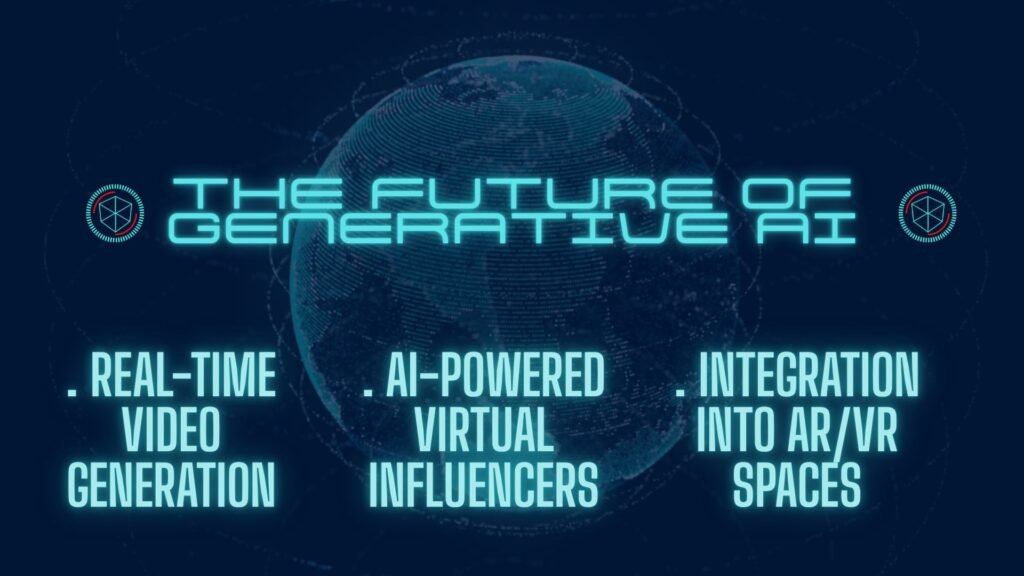
Predictions and Rising Trends:
. Real-time video generation
. AI-powered virtual influencers
. Integration into AR/VR spaces
What to Anticipate in the Next 5 Years:
Mass selection over businesses, more brilliant AI, and more human-AI collaboration. It won’t supplant us—but it will reshape how we make, work, and communicate.
Conclusion:
Generative AI isn’t just a buzzword—it’s a transformation in advanced imagination. From reclassifying how we deliver substance to opening modern domains of development, it’s getting to be a foundation of tomorrow’s world. Whereas it comes with challenges, its potential is endless, and it’s up to us to shape its future dependably. Prepared to investigate? The age of inventive AI is here.
Frequently Asked Questions
1. What are a few dangers of utilizing Artificial Intelligence Generative in business?
Risks include creating one-sided or wrong content, potential abuse for deepfakes or deception, and legal uncertainties around intellectual property. Businesses require the execution of moral rules and human oversight.
2. Do I require coding abilities to utilize Generative AI tools?
Not at all. Numerous devices like ChatGPT, DALL·E, Canva AI, and Jasper offer user-friendly interfaces that require no coding information, making them open to anybody.
3. Is Generative AI secure to use?
Yes, with legitimate rules. Moral utilization and mindful preparation are key.
4. How do I begin utilizing Generative AI tools?
Try stages like ChatGPT, DALL·E, and Runway ML. Most are beginner-friendly and free to explore.
5. What businesses will benefit most from Generative AI?
Creative areas, showcasing, healthcare, excitement, and computer program improvement are among the best recipients.