
Table of Contents
Web3 & Blockchain: Changing the Advanced World:
Web3 and blockchain have undergone significant changes over the past three decades. From the early, inactive web pages of the 1990s (Web1) to the intuitive, social, and mobile-driven Web2, the way we interface, share, and execute has advanced beyond creative energy. This move is not a specialized overhaul; it is a crucial alteration in how we approach belief, proprietorship, and the web itself.
(Understanding Web3) The Decentralized Web:
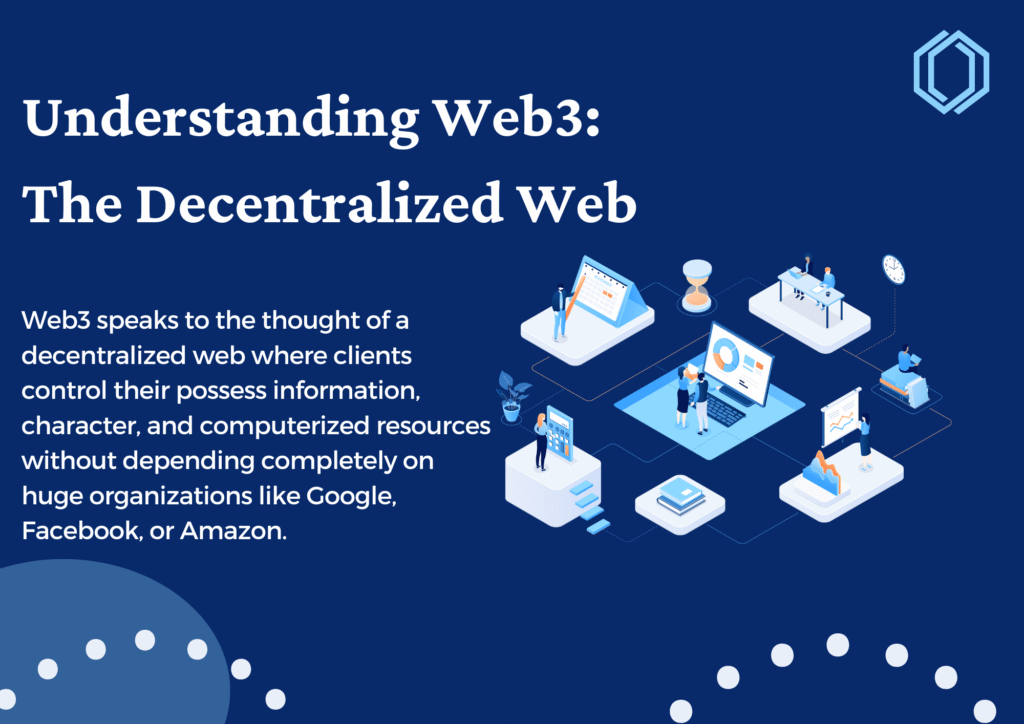
Web3 & Blockchain speak to the thought of a decentralized web where clients control their own information, identity, and digital resources without depending completely on huge organizations like Google, Facebook, or Amazon. Instead of information being put away on centralized servers claimed by a few companies, Web3 applications work on decentralized systems, regularly built utilizing blockchain technology.
In Web2, we “borrow” stages — we post on Facebook, but the company possesses our substance and information. In Web3, we really possess our information. Our computerized personality can move consistently over stages, and we can indeed monetize our own content without middlemen taking the lion’s share.
A straightforward way to think about it:
- Web1 = Read-only (inactive websites)
- Web2 = Perused and type in (social media, apps, intelligent websites)
- Web3 = Examined, type in, and claim (decentralized control, blockchain-based applications)
Blockchain The Spine of Web3:
The enchantment behind Web3 lies in blockchain — a conveyed record innovation that records transactions over numerous computers in a way that is secure, straightforward, and tamper-proof. Each “block” contains a set of exchanges, and once it’s included in the “chain,” it cannot be modified without changing each square after it — something for all intents and purposes outlandish without lion’s share control. Some key highlights of blockchain include:
Transparency – All exchanges are obvious and verifiable.
Security – Progressed cryptography guarantees assurance against hacking.
Real-World Applications of Web3 & Blockchain
Non-Fungible Tokens:
Craftsmen can offer their work straightforwardly to buyers, holding more benefits and royalties.
Decentralized Independent Organizations:
DAOs are community-led groups without centralized authority. Choices are made through voting by token holders, making administration straightforward and democratic.
Digital Identity:
With blockchain-based IDs, people can control their individual data and share it as it were when vital, diminishing the dangers of identity theft.
How Web3 Contrasts from Web2:
- Ownership – In Web2, stages claim the information; in Web3, clients do.
- Control – Web2 is run by centralized organizations; Web3 is run by decentralized protocols
- Privacy – Web3 offers more noteworthy client control over information sharing.
Benefits of Web3 & Blockchain:
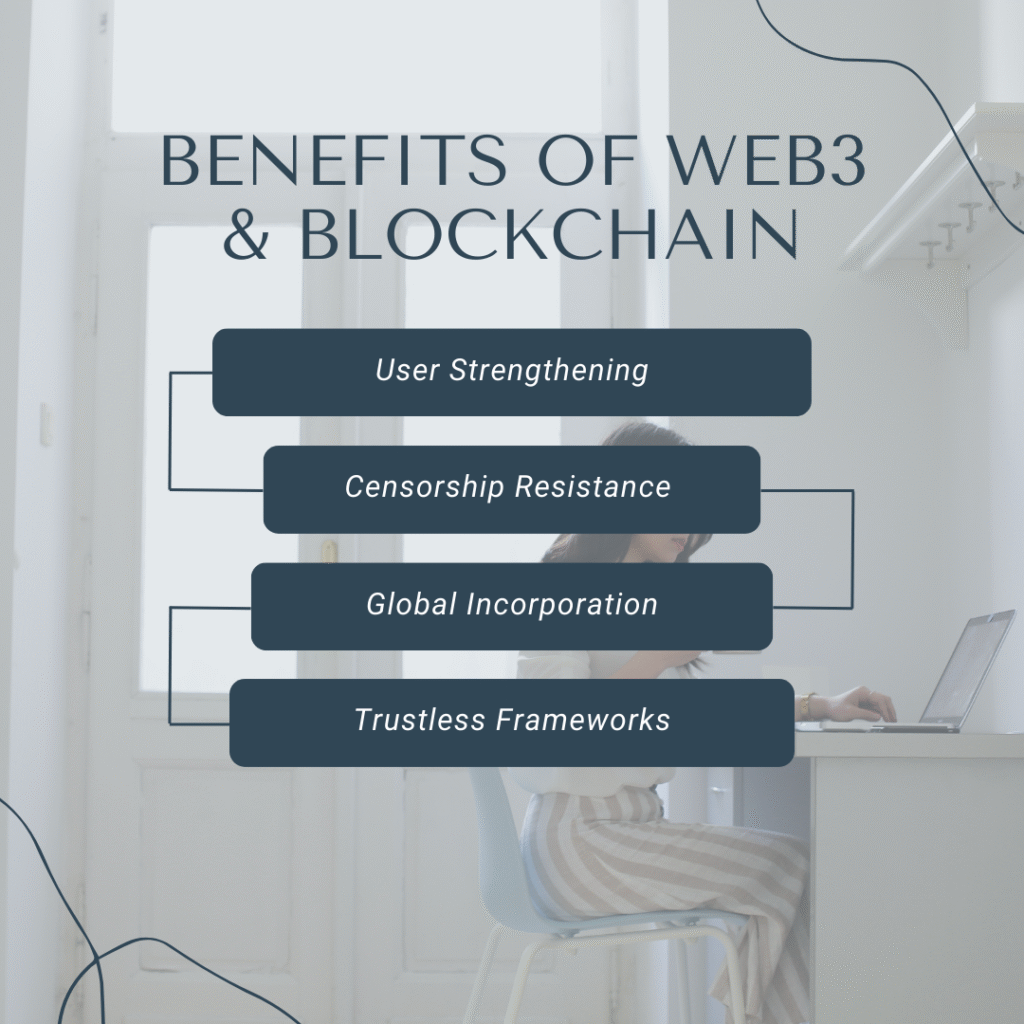
- User Strengthening – You are no longer a “product” whose information is sold; you control it.
- Censorship Resistance – Decentralized systems can’t effectively be closed down.
- Global Incorporation – Anybody with access to the web can take an interest in the computerized economy.
- Trustless Frameworks – No requirement to depend on a central specialist; belief is built into the code.
Challenges Confronting Web3 & Blockchain:
As progressive as these innovations are, they confront genuine hurdles
- Scalability – Blockchain systems can be more scalable compared to centralized systems.
- Energy Utilization – A few blockchains (like Bitcoin) require tall computational control, raising natural concerns.
- User Encounter – Web3 stages are regularly less natural than Web2 apps, restricting mass adoption.
The Future of Web3 & Blockchain:
Despite challenges, development is moving quickly. Ethereum’s move to Proof-of-Stake has, as of now, diminished its energy consumption drastically. Layer 2 scaling arrangements like Polygon are making exchanges speedier and cheaper.
In another decade, we may see:
- Mainstream Web3 Apps – Social media, gaming, and e-commerce platforms running totally on decentralized infrastructure.
- Metaverse Integration – Virtual universes where clients possess computerized assets, products, and identities.
- Mass Selection in Fund – DeFi is supplanting conventional managing an account in numerous areas.
- Global Character Arrangements – Blockchain-based IDs supplanting physical international IDs and driver’s licenses.
Why Web3 Things for the Normal User:
For most individuals, the specialized subtle elements of blockchain might appear overpowering, but the benefits are basic: more control, more flexibility, and more opportunities. Fair as social media reshaped how we communicate, Web3 might reshape how we claim, win, and exist online.
Imagine a world where:
- You win tokens each time you share important content.
- You vote on how your favorite stage is run — and get compensated for participating.
- You can send cash right away to anybody in the world without fees.
- You can send cash right away to anybody in the world without fees.
- You have one secure computerized personality for all online services.
This is the vision that Web3 and blockchain are working to achieve.
Conclusion:
Web3 and blockchain are not fair buzzwords — they are the building blocks of a more equitable, secure, and user-centric web. Whereas challenges stay, the energy is irrefutable. As with any innovative insurgency, early adopters will shape the scene, but over time, these devices seem to be as undetectable and basic as the smartphones we utilize each day.
Frequently Asked Questions
What is Web3 in regular language?
Web3 is the modern adaptation of the web where individuals can claim their information, cash, and advanced things in step with companies controlling everything.
How does blockchain work in basic terms?
Blockchain is like an open notebook shared by thousands of computers. Once something is composed in it, no one can subtly delete or alter it.
Do I require cryptocurrency to utilize Web3?
Not continuously. A few Web3 apps utilize crypto, but numerous ventures center on computerized personality, gaming, and supply chain tracking without requiring coins.
Why are individuals energized by decentralization?
Because it takes control away from a few huge companies and gives clients more flexibility, straightforwardness, and control.
What precisely are savvy contracts?
They are computerized assertions composed in code. Once conditions are met, they run naturally without legal counselors or banks.
Why are NFTs so well-known in Web3?
NFTs let individuals demonstrate possession of special computerized things like craftsmanship, music, or even arrive in virtual worlds.